
If you’re reading this, chances are you know what it feels like to search for answers for your child. Maybe you’ve spent months—or even years—moving from one appointment to another, filling out forms, sitting in waiting rooms, talking with teachers, meeting with specialists, and trying to make sense of conflicting advice. You knew something wasn’t adding up, even when other people told you to wait, be patient, or stop worrying.
Then, eventually, someone gave you a name for what your child was experiencing. Autism. ADHD. Sensory Processing Disorder. Anxiety. A developmental delay. For many parents, that moment brings relief and uncertainty at the same time. There can be relief in finally having language for what you’ve been seeing, especially if the diagnosis opens the door to services, accommodations, therapies, or support. But there can also be a quieter question underneath it all: Will this diagnosis help people understand my child, or will it start to define what everyone believes is possible for them?
At New Hope Chiropractic, we believe a diagnosis can be a very useful tool. We also believe your child is much bigger than any diagnosis written in their chart.
A Diagnosis Can Open Important Doors
There are very real reasons families pursue a diagnosis. For some children, it may provide access to an IEP, 504 Plan, school accommodations, speech therapy, occupational therapy, physical therapy, developmental services, behavioral or mental-health support, or specialized programs. It may help with insurance coverage or simply give parents and teachers a clearer framework for understanding what a child needs.
Sometimes the greatest benefit is validation. After hearing comments like “they’ll grow out of it,” “they’re just strong-willed,” or “you need to be more consistent,” a diagnosis can finally confirm that the challenges you’ve been seeing are real. That matters. It can change the conversation from, “Why won’t this child behave?” to, “What does this child need in order to be successful?”
That shift can be incredibly valuable.
But a Diagnosis Should Describe Your Child, Not Define Them
The difficulty comes when the diagnosis stops being a helpful tool and starts becoming the lens through which everyone sees the child.
A child who loves reading, has an incredible memory, and struggles with transitions can quickly become “the autistic child.” A funny, imaginative child who has difficulty regulating attention can become “the ADHD kid.” The diagnosis may explain certain patterns, but it cannot possibly explain the whole person.
Your child still has strengths, interests, relationships, personality, talents, goals, and potential. Those parts of their story are just as important as the challenges that led to the evaluation in the first place.
Not Every Challenge Has to Be Explained by the Label
Once a child has a diagnosis, it can become easy to attribute every new struggle to it. Poor sleep may be brushed off as part of ADHD. Constipation may be considered something that simply comes with autism. Anxiety may be dismissed as part of their personality. Sensory overload may be accepted as something that will always be there.
But sometimes there are other pieces worth exploring.
A diagnosis tells us that a child meets certain criteria based on symptoms, development, or behavior. It does not necessarily explain every contributing factor behind those struggles. A child with ADHD may also be exhausted from poor sleep. A child with autism may also struggle with constipation, anxiety, feeding, or sensory overload. A child with sensory challenges may also have a nervous system that has difficulty recovering after stress.
At New Hope Chiropractic, this is why we like to broaden the question. Instead of asking only, “How do we manage the diagnosis?” we also ask, “How is this child’s nervous system functioning and adapting?”
Why We Pay Attention to the Nervous System
Your child’s nervous system plays a role in nearly everything they do. It helps coordinate movement, sensory processing, sleep, digestion, attention, emotional responses, breathing, heart rate, stress responses, recovery, and social engagement.
That does not mean nervous-system dysfunction is the single cause of autism, ADHD, anxiety, or other developmental diagnoses. These conditions are complex and can involve genetics, development, environment, physiology, and many other factors. But nervous-system regulation can influence how a child experiences everyday life and how well they adapt to stress.
That makes it worth evaluating.
One way we explain this to parents is by comparing the autonomic nervous system to a car with a gas pedal and a brake pedal. The sympathetic nervous system is the gas pedal. It helps the body respond to challenge and increases alertness when action is needed. The parasympathetic side helps with rest, digestion, recovery, and returning to a calmer baseline.
Children need both. The goal isn’t to eliminate stress. The goal is for the nervous system to be able to respond appropriately and then recover.
Some children seem to have plenty of gas pedal but struggle to find the brake. Others move between overactivation and exhaustion. That can sometimes show up as big emotional reactions, difficulty calming, poor sleep, sensory overwhelm, trouble focusing, chronic tension, digestive struggles, or crashing after school.
Those patterns can exist alongside a diagnosis, and they may still deserve attention.
Why Your Child’s Whole Story Matters
When a child comes into New Hope Chiropractic, we don’t begin their story on the day they received a diagnosis. We go back much further. We ask about pregnancy, birth, infancy, feeding, sleep, digestion, motor development, illness, injuries, sensory development, emotional regulation, and school.
We do this because nervous-system development happens over time.
Some families describe a combination of stressors throughout early life, which is sometimes referred to as the “Perfect Storm.” That may include a stressful pregnancy, a complicated birth, C-section, forceps or vacuum delivery, colic, reflux, feeding difficulty, torticollis, constipation, ear infections, chronic sleep struggles, or sensory challenges.
None of those experiences automatically causes autism, ADHD, anxiety, or another diagnosis. Human development is far more complex than that. But when we’re trying to understand how a child’s nervous system is adapting today, their history can provide meaningful context.
What About Multiple Diagnoses?
Many parents find that the labels accumulate over time. It may start with speech delay, then sensory processing challenges, then ADHD or anxiety, and eventually autism or another developmental diagnosis. That naturally raises the question of whether these are all completely separate issues.
Sometimes they are distinct conditions that deserve their own evaluation and support. But there can also be overlap. Poor sleep can make attention more difficult. Sensory overload can contribute to emotional reactions. Anxiety can affect digestion. A child who struggles to communicate may become frustrated more easily. A nervous system that has difficulty regulating can make transitions feel much harder.
The brain and body do not operate as separate departments, so we believe a whole-child approach matters.
You Can Accept the Diagnosis and Still Ask More Questions
This doesn’t have to be an either-or decision.
You can accept your child exactly as they are and still want to support areas where they are struggling. You can appreciate the diagnosis and continue asking questions. You can use an IEP and evaluate nervous-system function. You can work with an occupational therapist and a chiropractor. You can use appropriate medical treatment while also prioritizing sleep, nutrition, movement, and regulation.
We believe collaborative care is often the most helpful approach because different professionals can address different pieces of the puzzle.
Where Neurological INSiGHT Scans Come In
At New Hope Chiropractic, we use Neurological INSiGHT Scans to gather objective information about patterns related to nervous-system function. These scans do not diagnose autism, ADHD, sensory processing disorder, anxiety, or developmental conditions. They are designed to look at something different.
Heart rate variability, or HRV, gives us information about autonomic adaptability and how effectively the body appears to shift between activation and recovery. Surface EMG measures electrical activity associated with the muscles supporting the spine, helping us evaluate patterns of muscular tension, energy use, and coordination. NeuroThermal scanning measures temperature patterns along the spine that are influenced in part by autonomic regulation.
Together, these scans help us better understand how much stress and tension a child’s nervous system may be carrying. We combine those findings with their health history, examination, current challenges, and the family’s goals so that we are not relying only on symptoms or guesswork.
Where Chiropractic Fits Into the Bigger Picture
Neurologically focused chiropractic care is not intended to replace an autism evaluation, ADHD treatment, occupational therapy, speech therapy, counseling, behavioral support, or appropriate medical care.
Our role is different.
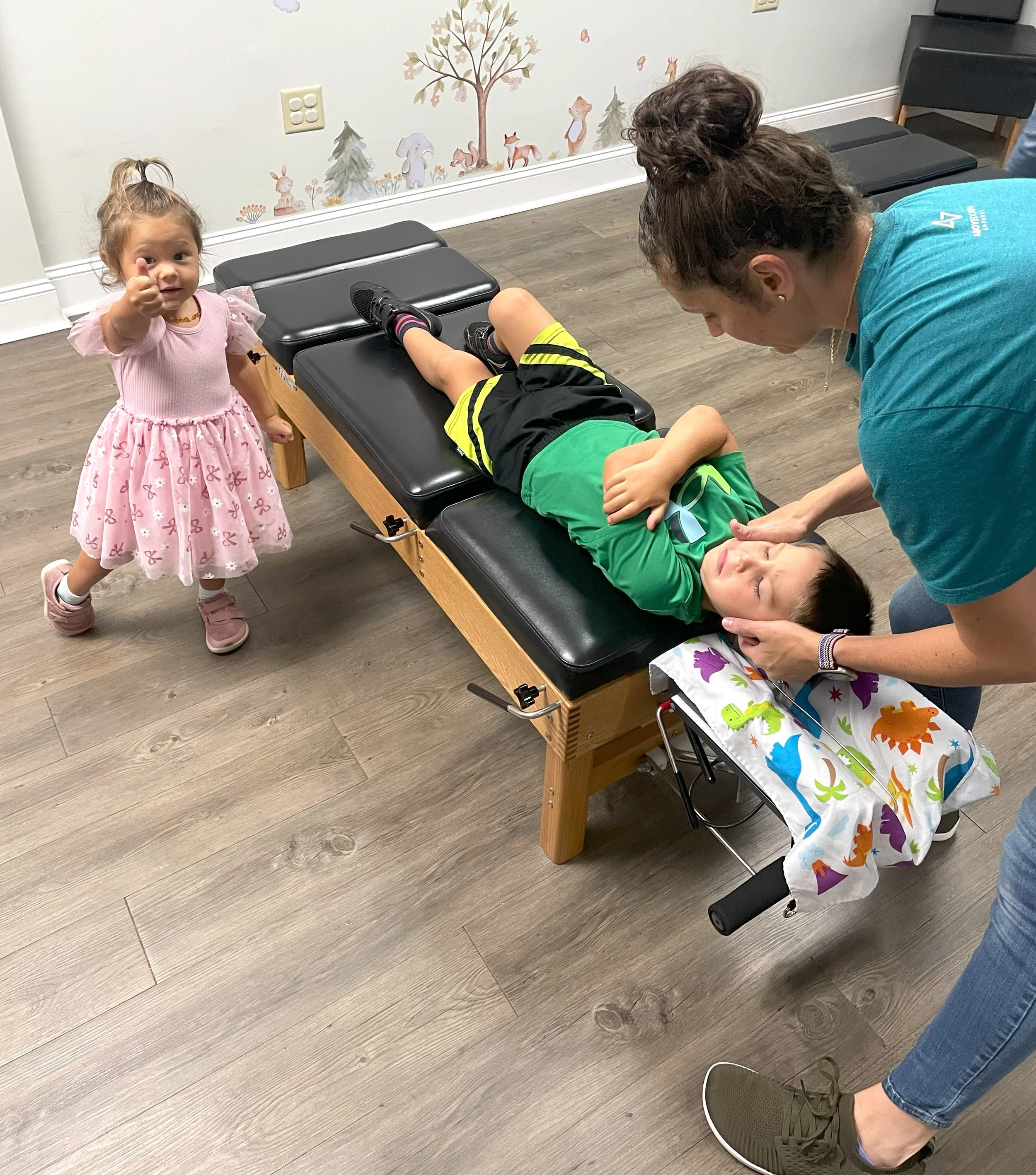
When we identify patterns of neurospinal stress, we use gentle, specific chiropractic adjustments tailored to the child’s age, needs, and findings. Over time, we also pay attention to how the child is adapting in everyday life. Parents may notice changes in areas such as sleep, digestion, emotional regulation, transitions, sensory tolerance, focus, and the ability to recover after stressful situations.
We also periodically repeat Neurological INSiGHT Scans so we can compare objective findings over time.
The goal is not to change who a child is. The goal is to support their ability to function, regulate, adapt, and experience the world with greater capacity.
Hope Does Not Mean Denial
Some parents worry that having hope means they are not accepting their child’s diagnosis. We don’t believe those things are opposites.
You can fully love and accept the child standing in front of you today while still believing in their ability to grow. You can celebrate progress without suggesting that who they were before wasn’t enough. You can seek support without trying to erase their personality, and you can acknowledge real challenges without deciding too early what their limits will be.
Hope simply leaves room for development.
And children deserve that room.
Let the Diagnosis Open Doors—Not Close Them
Use the diagnosis. Take the accommodations. Build the support team. Ask for the IEP. Find the therapist who understands your child. Connect with other parents. Learn everything you can.
But don’t let one word become the entire story.
Your child is still developing, still learning, still adapting, and still surprising you. A diagnosis can help explain part of the journey, but it does not get to write the ending.
At New Hope Chiropractic in Charleston, South Carolina, we help families take a closer look at nervous-system stress and adaptability through Neurological INSiGHT Scans and gentle, individualized chiropractic care. If you’re wondering whether there may be another piece of your child’s health story worth exploring, we’d be honored to sit down, listen, and take a closer look together.
Related Articles
Are We Just Labeling Instead of Helping Them?
The Perfect Storm: Insights Into Childhood Neurological Disorders
Too Many Therapies, Not Enough Results?
