
Ear Infections, Antibiotics, and Asthma: Understanding the “Perfect Storm”
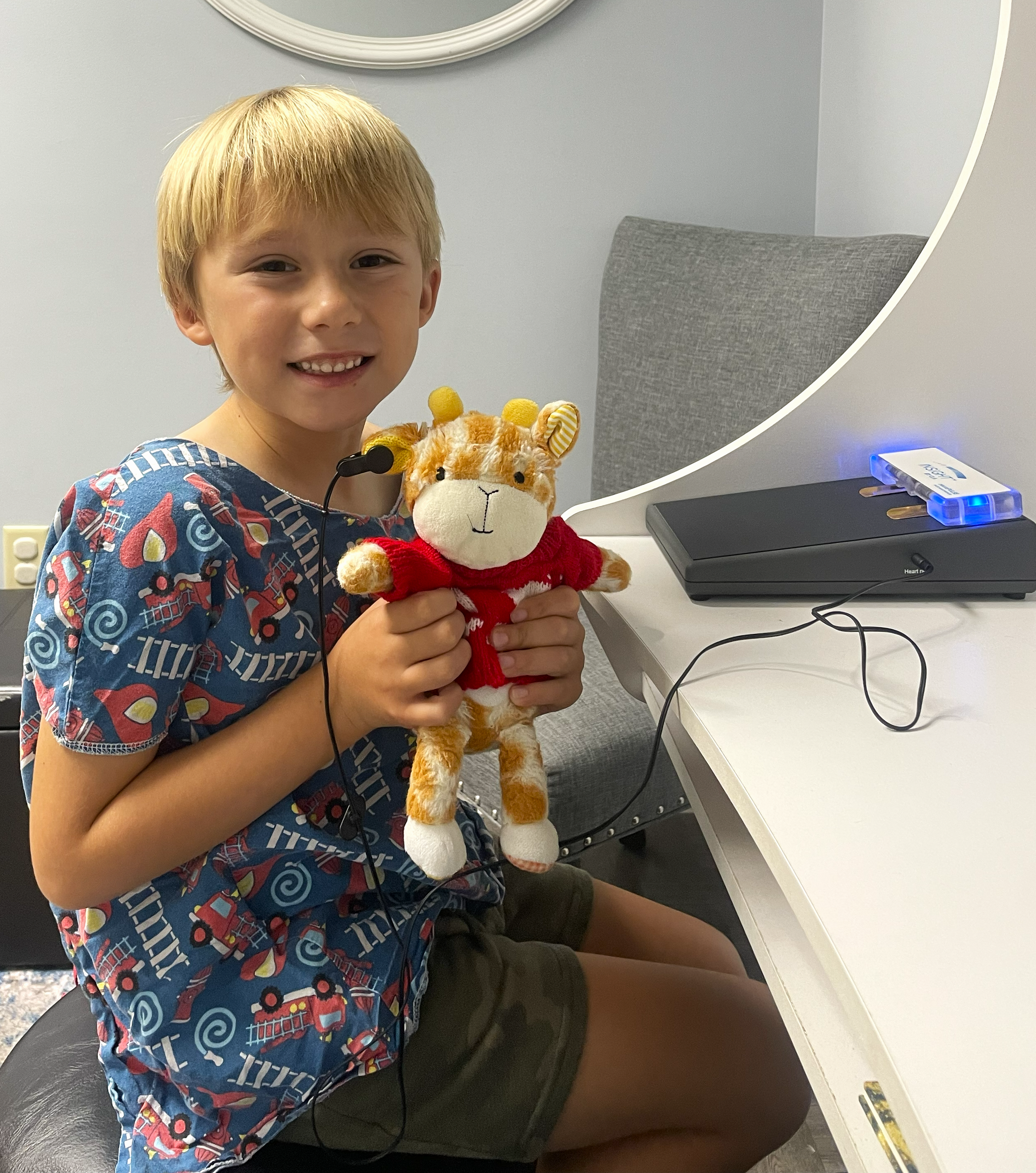
It starts with a cold.
A few days later, your baby or toddler is pulling at their ear, waking up screaming, running a fever, or suddenly miserable. You head to the pediatrician and hear the words ear infection.
Maybe there's an antibiotic. Things settle down.
Then another cold comes through the house—and you're right back where you started.
For some families, this becomes a frustrating cycle: recurring ear infections, round after round of antibiotics, disrupted sleep, missed daycare, worried parents, and eventually a conversation about an ENT referral or ear tubes.
And at some point, many parents start asking a very reasonable question:
Why does this keep happening to my child?
At New Hope Chiropractic, that's exactly the kind of question we want families to ask.
Because treating an acute infection when treatment is needed is important. But when the same pattern keeps repeating, we also want to step back and look at the bigger picture: ear anatomy and drainage, immune development, inflammation, the microbiome, and the nervous system responsible for coordinating so many of these functions.
For some kids, recurring ear infections aren't an isolated event. They're one part of a much larger story.
Why Are Ear Infections So Common in Kids?
There's an anatomical reason babies and young children are particularly susceptible to middle-ear problems.
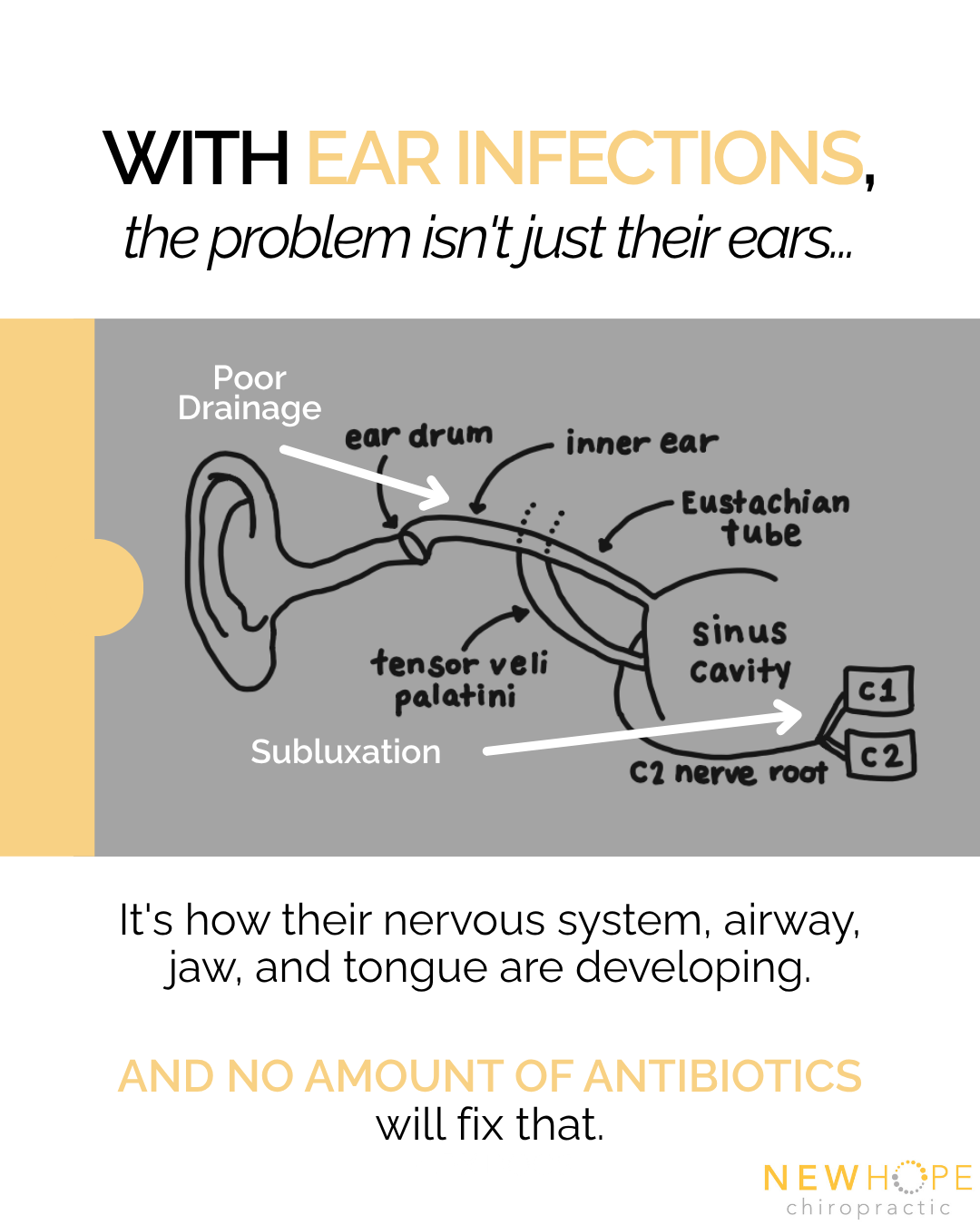
The Eustachian tubes connect the middle ear to the back of the throat and help ventilate the middle ear and clear fluid. In young children, these tubes are shorter, narrower, and more horizontal than they are in adults, which can make drainage less efficient.
When a child gets a cold or another upper-respiratory illness, inflammation and congestion can interfere with normal Eustachian-tube function. Fluid can accumulate behind the eardrum, creating an environment where an acute middle-ear infection may develop.
It's also important to distinguish an actual acute middle-ear infection from middle-ear effusion, which means fluid is present without an active infection.
That's one reason simply asking, “How do we get rid of this infection?” doesn't always answer the bigger question for a child who experiences the same problem over and over.
We also want to ask:
Why does this child's system seem to have such a difficult time returning to baseline?
The Nervous System Piece Most Parents Never Hear About
The ears don't function in isolation from the rest of the body.
The muscles involved in swallowing and Eustachian-tube function, the upper cervical region, cranial nerves, lymphatic and vascular systems, immune system, and autonomic nervous system are all part of a much larger physiological picture.
This is where New Hope looks at recurring ear infections a little differently.
We don't believe every ear infection means a child has a chiropractic problem. And we don't use chiropractic adjustments to treat the bacteria or viruses responsible for an acute infection.
Instead, we're interested in the child's neurological foundation.
How well is their nervous system regulating?
How well are they adapting to stress?
How efficiently do they move from a state of activation back toward rest, digestion, recovery, and regulation?
Those questions become especially interesting when the ear infections are accompanied by other challenges—poor sleep, reflux, constipation, chronic congestion, sensory sensitivity, difficulty settling, frequent illness, or a child who seems to live with their nervous system constantly stuck on high alert.
That's when we begin to see what we often call the Perfect Storm.
Sometimes the Story Starts Much Earlier Than the First Ear Infection
When a family comes to New Hope with a child experiencing recurring ear infections, we don't begin their history with the first antibiotic prescription.
We go all the way back.
What was pregnancy like? What was birth like? Was there induction, a long labor, a very fast delivery, vacuum or forceps assistance, or a C-section? How did feeding go? Did baby struggle with reflux, colic, constipation, torticollis, poor sleep, or difficulty settling? How frequently has the child been sick? What other stressors has their developing nervous system experienced?
None of those things automatically causes an ear infection.
And having a C-section, assisted birth, or colicky baby does not mean a child is destined to develop chronic ear problems.
What we're looking for is the accumulation of stress.
At New Hope, the Perfect Storm describes the idea that some children experience layer after layer of neurological, physical, immune, and environmental stress until their system seems to have less capacity to adapt when the next challenge arrives.
For one child, that may show up primarily as sleep struggles.
For another, digestion.
For another, sensory and emotional dysregulation.
And for some families, one of the first recurring patterns they notice is that every cold seems to end in another ear infection.
What About Antibiotics?
This is an area where the conversation can become unnecessarily polarized.
Antibiotics aren't “bad,” and there are absolutely situations where they're appropriate and important.
Acute otitis media can be caused by bacteria, and children with severe symptoms or certain clinical presentations should receive antibiotics. Current pediatric guidance also allows watchful waiting for 48–72 hours in selected children with mild acute otitis media, provided appropriate follow-up is available.
In fact, the CDC reports that about 2 out of 3 children with mild ear infections improve without antibiotics when they're appropriate candidates for watchful waiting.
That's very different from saying antibiotics don't work for ear infections.
They can work—and sometimes they're exactly what a child needs.
The bigger issue is that an antibiotic is designed to address susceptible bacteria during that particular infection. It isn't designed to explain why a particular child continues developing recurrent infections or persistent middle-ear fluid.
Repeated antibiotic exposure also isn't completely neutral. Antibiotics can cause adverse effects and contribute to antibiotic resistance; the CDC reports adverse effects in roughly 4–10% of children treated with antibiotics for acute otitis media.
That's why appropriate antibiotic stewardship matters.
Where Do Allergies and Asthma Enter the Conversation?
This is where the original “Perfect Storm” conversation gets especially interesting—but also where we need to be careful not to confuse association with causation.
Large observational studies have found associations between antibiotic exposure during infancy and a higher later incidence of several allergic conditions, including asthma and allergic rhinitis. One large cohort published in JAMA Pediatrics, for example, found that infants who received antibiotics had higher rates of later allergic diseases, including asthma.
That does not prove that antibiotics caused those children to develop asthma.
Children who require antibiotics frequently may already differ from children who don't in ways that influence later health. Infection burden, genetics, immune development, microbiome differences, environmental exposures, and other factors can all complicate the relationship.
But it does give us another reason to avoid thinking about repeated infections, antibiotic exposure, immune development, allergies, and respiratory health as completely unrelated events.
At New Hope, this is exactly what we mean when we talk about looking at the whole child instead of chasing one symptom at a time.
What About Ear Tubes?
For children with recurrent acute otitis media or persistent middle-ear fluid, an ENT may recommend tympanostomy tubes.
Ear tubes create ventilation through the eardrum and can be an appropriate tool for selected children. They can be especially important when persistent fluid is affecting hearing or when a child meets other clinical criteria.
We don't tell parents that tubes are always unnecessary, and chiropractic care shouldn't replace an appropriate ENT evaluation.
But we also understand why a parent whose child has experienced infection after infection wants to know whether there are other aspects of their child's health worth evaluating.
Our answer is yes.
Not because we believe an adjustment replaces a tube or antibiotic, but because recurring problems deserve a broader conversation about the child's overall ability to regulate, recover, and adapt.
The Immune System and Nervous System Are Constantly Communicating
One of the biggest misconceptions about health is that the body operates as a collection of separate systems.
It doesn't.
The brain, autonomic nervous system, endocrine system, gut, and immune system communicate constantly.
Your child's autonomic nervous system helps coordinate many automatic functions involved in stress, recovery, digestion, circulation, sleep, and inflammatory and immune signaling.
At New Hope, we often explain this with the gas pedal and brake pedal analogy.
The sympathetic nervous system acts somewhat like the gas pedal. It helps mobilize the body when something demands action.
The parasympathetic nervous system functions more like the brake pedal, supporting rest, digestion, recovery, and a return toward baseline.
Your child needs both.
The goal isn't to keep the nervous system “calm” all the time. A healthy child should be able to activate appropriately when they're fighting an illness, running across the playground, or responding to something stressful.
What matters is the ability to shift gears.
Can their system respond appropriately when stress arrives—and then return toward regulation and recovery afterward?
That's the piece we're especially interested in when a child seems to move from one challenge directly into the next.
Looking Beneath the Recurring Pattern
This is why our approach at New Hope Chiropractic begins with much more than asking where it hurts.
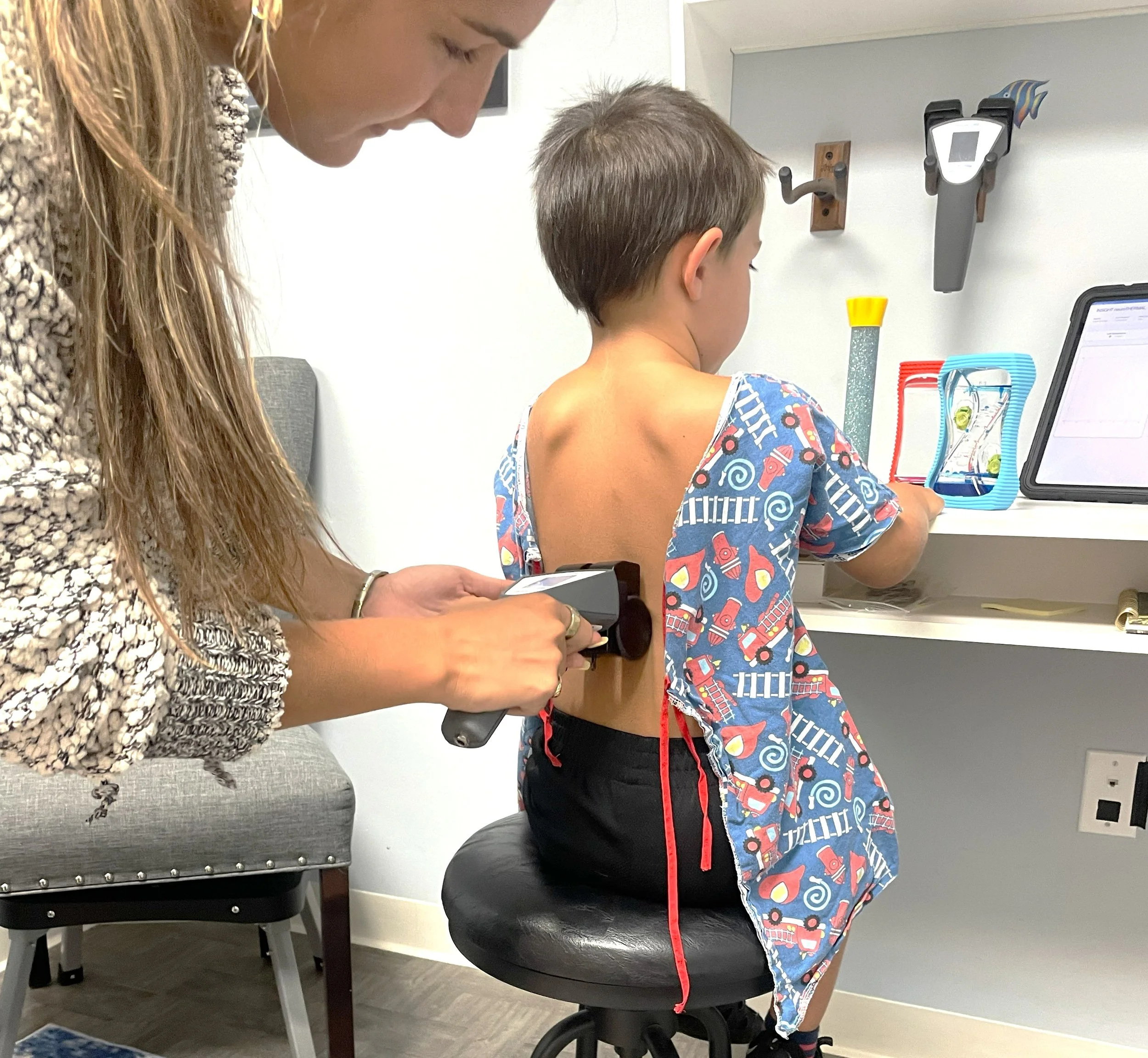
We take a detailed history and use Neurological INSiGHT Scans to evaluate patterns associated with nervous-system stress, tension, coordination, and adaptability.
These scans do not diagnose ear infections, immune deficiency, allergies, or asthma, and they don't tell us whether your child needs an antibiotic or ear tubes.
They give us information about a different part of the picture.
Our Heart Rate Variability (HRV) assessment provides information about autonomic adaptability and how the nervous system is balancing activation and recovery.
Our NeuroSpinal EMG measures electrical activity associated with the muscles supporting the spine, allowing us to evaluate patterns of muscular tension, energy use, and coordination.
Our NeuroThermal Scan evaluates temperature patterns along the spine that can be influenced in part by autonomic regulation.
Together with your child's history and examination, those scans help us better understand the neurological foundation underneath the symptoms you're seeing.
Where Neurologically Focused Chiropractic Care Fits
If our examination and scans indicate that chiropractic care is appropriate, we use gentle, specific adjustments designed around the individual child's neurological findings.
For babies and young children, those adjustments look very different from what many parents imagine when they hear the word “chiropractic.” Our approach is gentle, specific, and adapted to the child's age, size, and needs.
We're not adjusting an ear infection away.
We're also not claiming chiropractic care kills bacteria, eliminates viruses, replaces antibiotics when they're medically indicated, or guarantees that a child won't need tubes.
Our focus is the neurospinal system and the child's capacity for regulation and adaptability.
And then we measure progress.
At New Hope, we periodically repeat Neurological INSiGHT Scans during active care so we can compare objective neurological patterns with what parents are noticing at home.
How is the child sleeping? How are they handling stress? How quickly do they bounce back after illness? How is digestion? How is regulation? What patterns are changing?
We're looking at the child—not simply counting ear infections.
The Goal Isn't to Fear the Next Cold
If you're constantly wondering whether the next runny nose is going to become another ear infection, another sleepless night, another antibiotic, or another trip to the pediatrician, it's understandable to want more information.
Continue working with your child's pediatrician and ENT when appropriate. Ear pain, high fever, ear drainage, worsening symptoms, hearing concerns, or symptoms lasting more than a few days warrant medical evaluation.
And at the same time, don't be afraid to ask a bigger question:
What else could be contributing to the pattern we're seeing?
At New Hope Chiropractic in Charleston, South Carolina, that's where we come in.
Through a detailed history, neurological examination, and Neurological INSiGHT Scans, we can evaluate how your child's nervous system is functioning and determine whether Neurologically Focused Chiropractic Care may be an appropriate complementary piece of their overall care.
Because when the same problem keeps happening over and over again, sometimes the next step isn't simply asking what to do about the next infection.
It's stepping back and looking at the whole child.
Related Articles
The Real Reason Your Child Keeps Getting Sick
Why Is Vagus Nerve Health So Important for Our Kids?
The Perfect Storm: Insights into Childhood Neurological Disorders
Tackling Nervous System Dysregulation for Lasting Health: A Guide for Parents
