
Why “More Salt and Stand Up Slowly” Isn’t Enough: Understanding POTS and the Nervous System
If your teen or young adult has been diagnosed with POTS, you already know how quickly it can change everyday life.
Maybe they were once playing sports, going to school, spending time with friends, and keeping up with a full schedule. Then seemingly ordinary things—standing up, taking a shower, walking across a room, or sitting through a school day—became exhausting.
Their heart races when they stand. They feel dizzy or lightheaded. Headaches, nausea, fatigue, exercise intolerance, and brain fog begin interfering with school and activities. Some kids feel like they might faint simply from being upright too long.
Eventually, you hear the words Postural Orthostatic Tachycardia Syndrome, or POTS.
And while finally having a name for what is happening can be validating, many families leave the diagnosis with an entirely new set of questions.
Why is this happening? Why is standing such a challenge for their body? Why are there symptoms involving the heart, digestion, energy, temperature, sleep, and brain all at once? And is there more we can do besides increasing fluids and salt and learning to stand more slowly?
To understand why POTS can affect so many seemingly unrelated parts of the body, we first have to understand something incredibly important:
POTS is a disorder of the autonomic nervous system—a form of dysautonomia.
What Exactly Is POTS?
POTS stands for Postural Orthostatic Tachycardia Syndrome. It is a chronic form of orthostatic intolerance in which symptoms occur when a person is upright and are accompanied by an excessive increase in heart rate.
In adolescents, the diagnostic heart-rate threshold is generally an increase of at least 40 beats per minute within 10 minutes of standing or upright tilt; in adults, it is generally at least 30 beats per minute. Diagnosis also requires looking at the complete clinical picture and excluding other explanations for the elevated heart rate.
But anyone living with POTS knows it is about much more than a number on a heart-rate monitor.
People with POTS may experience dizziness, lightheadedness, fainting or near-fainting, heart palpitations, extreme fatigue, headaches, brain fog, exercise intolerance, nausea, digestive difficulties, sleep disturbances, shakiness, and temperature sensitivity. Symptoms can vary considerably from person to person.
That wide range of symptoms starts to make more sense once you understand the system involved.
POTS Is Dysautonomia
The autonomic nervous system controls many of the functions your body performs automatically. You don't consciously tell your heart how quickly to beat when you stand up. You don't consciously direct blood vessels to constrict, regulate digestion, control sweating, or continually adjust blood pressure.
Your autonomic nervous system handles those jobs in the background.
When you move from lying down to standing, gravity causes blood to shift downward. A healthy autonomic response makes rapid adjustments to heart rate, blood-vessel tone, and circulation to keep enough blood returning to the heart and brain.
In POTS, that response doesn't work normally. The body compensates with an excessive increase in heart rate, and the person may experience a cascade of symptoms simply from being upright.
This is why we don't think the nervous system should be a side conversation for families dealing with POTS.
It's central to understanding the condition.
The Gas Pedal and Brake Pedal
At New Hope Chiropractic, one of the easiest ways we explain autonomic regulation is by comparing the nervous system to a car.
The sympathetic nervous system functions somewhat like the gas pedal. It helps mobilize the body for action, increasing alertness and preparing us to respond to stress.
The parasympathetic nervous system functions more like the brake pedal, supporting processes associated with rest, digestion, recovery, and returning toward baseline. The vagus nerve is a major pathway of this parasympathetic system.
We need both.
A healthy nervous system isn't one that stays calm all the time. It's one that can appropriately respond to a challenge and then adapt and recover.
With dysautonomia, that regulation becomes disrupted.
That is why someone with POTS can experience symptoms across so many different systems. The autonomic nervous system is involved in cardiovascular regulation, digestion, temperature control, sweating, and many other automatic functions.
At New Hope, one of the questions we want to answer is not simply, “What symptoms does this child have?”
We want to understand:
How well is their nervous system regulating and adapting?
So Where Does the Vagus Nerve Fit In?
You've probably heard us talk about the vagus nerve quite a bit at New Hope, and for good reason.
The vagus nerve travels from the brainstem into the neck, chest, and abdomen and is an important part of parasympathetic regulation. It participates in communication involving heart rate, digestion, breathing, and other functions.
But it's important not to oversimplify POTS into a “vagus nerve problem.”
POTS is a heterogeneous condition, meaning there isn't one mechanism responsible for every case. Researchers describe different and sometimes overlapping mechanisms, including neuropathic POTS, hyperadrenergic states, hypovolemia, impaired blood-vessel regulation, immune-related mechanisms, and other contributors.
So rather than saying, “We need to fix the vagus nerve,” we look at the larger autonomic picture.
Is this nervous system showing healthy flexibility and adaptability, or does it appear to be struggling to regulate?
That distinction matters.
Why Did This Happen to My Child?
This is one of the hardest questions parents ask, and unfortunately, there isn't always one simple answer.
POTS can develop following a viral illness or other significant physiological stressor, and it has received increased attention because some people develop POTS or POTS-like dysautonomia following COVID-19. POTS is also associated in some patients with conditions such as hypermobile Ehlers-Danlos syndrome and mast cell activation disorders.
For other people, the beginning isn't nearly as obvious.
This is where we think the whole health history matters.
At New Hope Chiropractic, we don't start the conversation on the day someone received their POTS diagnosis. We want to know what their nervous system has experienced over time.
What was their health like before symptoms began? Were there earlier signs of autonomic difficulty? How was their sleep? Digestion? Stress tolerance? Sensory system? Were they frequently dizzy before anyone thought to check their heart rate? Did symptoms begin after an illness, injury, prolonged period of stress, or another major change?
We sometimes describe the accumulation of physiological stressors over time as the Perfect Storm.
That doesn't mean we can point to one difficult birth, infection, stressful event, posture problem, or other experience and say, “That's what caused POTS.” Current evidence doesn't support making that conclusion.
Instead, we're trying to understand the load the nervous system has been carrying and its capacity to adapt to that load.
For some kids and young adults, the POTS diagnosis may be the first time anyone has stepped back and looked at their symptoms as part of a larger autonomic picture.
Why Salt, Fluids, Compression, and Slow Standing Can Help
One of the first recommendations many POTS families receive is to increase fluids and, when medically appropriate, sodium. Compression garments and strategies for changing position may also be recommended.
Those aren't meaningless recommendations.
Increasing fluid and sodium intake can help expand blood volume in appropriate patients, while compression can help reduce blood pooling in the lower body. Exercise or physical reconditioning is also an important component of treatment for many patients, although it often needs to begin gradually and be individualized to what the person can tolerate.
Depending on the individual, physicians may also use medications to address particular aspects of the condition.
These strategies can be genuinely helpful.
Our question is simply:
Should the conversation end there?
For a teenager whose entire life has been disrupted by dysautonomia, we believe it's reasonable to also look more closely at nervous-system function.
Looking at the Nervous System Differently
This is where New Hope Chiropractic's approach differs.
We're not trying to diagnose POTS with chiropractic testing. We're also not trying to replace a cardiologist, neurologist, physical therapist, pediatrician, or other clinician managing the condition.
We're evaluating another part of the picture.
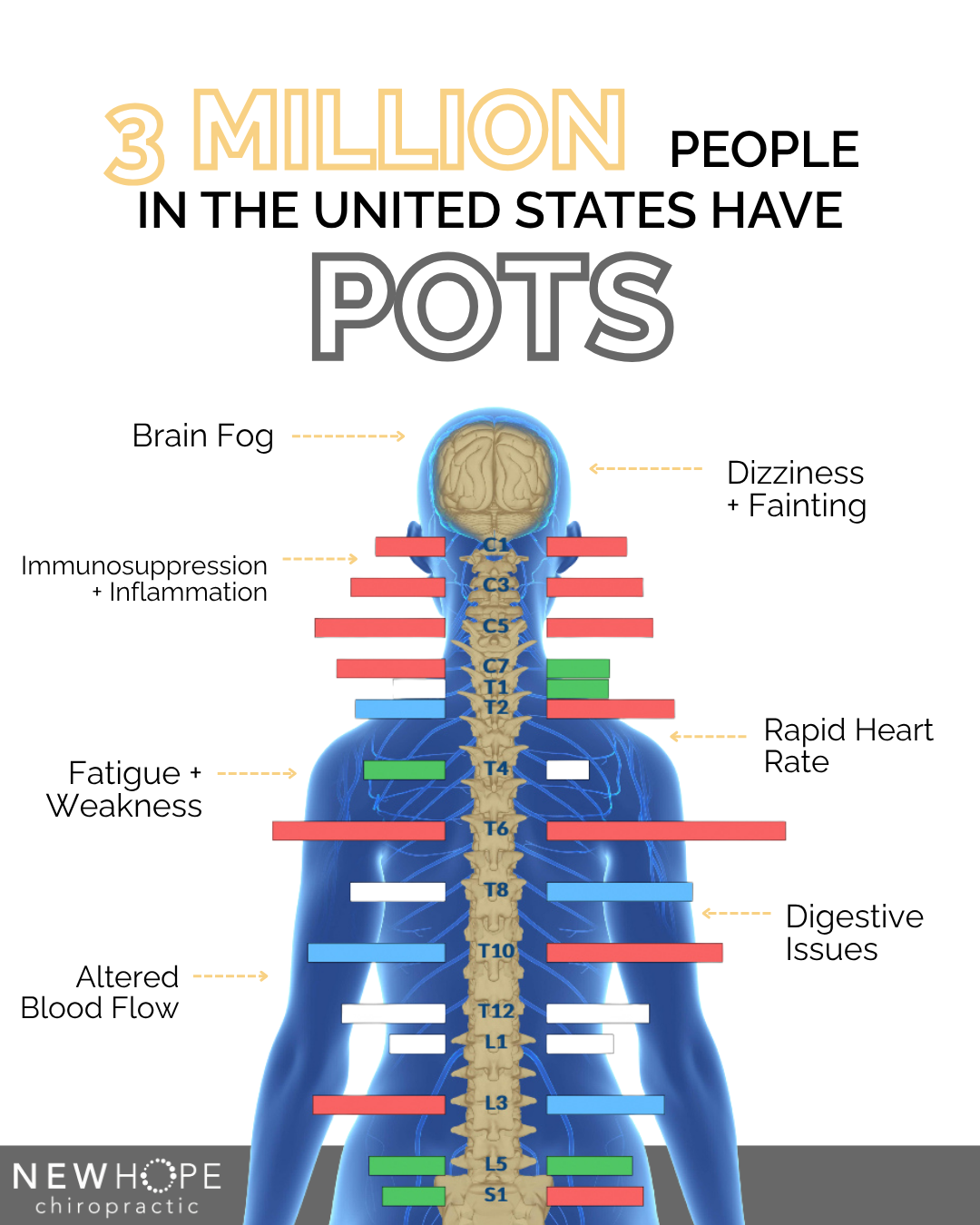
At New Hope, we use Neurological INSiGHT Scans to gather objective information about patterns related to nervous-system stress, tension, coordination, and adaptability.
These scans do not diagnose POTS or determine its underlying medical cause.
Instead, they help us evaluate how the nervous system appears to be functioning.
Our Heart Rate Variability (HRV) assessment gives us information about autonomic adaptability by examining variation in the timing between heartbeats.
Our NeuroSpinal EMG measures electrical activity associated with the muscles supporting the spine, helping us evaluate patterns of muscular tension, energy use, and coordination.
Our NeuroThermal Scan evaluates temperature patterns along the spine that can be influenced in part by autonomic regulation.
We then put those findings together with the person's complete history, examination, symptoms, and goals.
For someone already diagnosed with a disorder of autonomic regulation, we believe understanding that neurological picture can be an important additional piece of information.
Where Neurologically Focused Chiropractic Care Fits
When our examination and scans indicate that chiropractic care is appropriate, we use gentle, specific adjustments designed around that individual's neurological findings.
We aren't adjusting someone to “cure POTS,” and we don't tell families to stop the hydration, electrolytes, compression, exercise, medication, or medical treatment that their healthcare team has recommended.
Instead, our focus is on supporting the neurospinal system and the nervous system's capacity for regulation and adaptability.
That's an important distinction.
POTS is complex, and there is no single treatment that works for every person. We believe these patients deserve a team that recognizes that complexity.
For some families, that may mean cardiology and physical therapy. For others, neurology, immunology, or other specialties may also be involved. Nutrition, hydration, sleep, appropriately paced movement, and emotional support can all matter.
Neurologically Focused Chiropractic Care can be another piece of that larger plan.
Progress Should Be Measured, Not Guessed
One thing that's especially important to us at New Hope is being able to track what we're doing.
If we're telling a family that we're interested in nervous-system function, we want a way to periodically reassess it.
That's why we repeat Neurological INSiGHT Scans at progress evaluations during care. We can compare those objective patterns with what the patient and family are noticing in everyday life.
Are they tolerating more activity? How are they sleeping? How is digestion? How quickly do they recover after a stressful day? How is their energy? Are they able to participate more fully in school, family life, or activities?
For someone living with a condition that can fluctuate significantly, looking at both objective findings and real-life function gives us a much better picture than simply asking, “Are you feeling better today?”
Your Child Deserves More Than a Shaker of Salt
Salt, hydration, compression, exercise, medication, and other conventional POTS strategies can all have important roles. This isn't about throwing those tools away.
It's about recognizing what the diagnosis itself is telling us:
The autonomic nervous system is struggling to regulate normally.
So we believe the nervous system deserves to be part of the conversation.
If your teen or young adult is dealing with unexplained dizziness, a racing heart when standing, crushing fatigue, brain fog, headaches, exercise intolerance, digestive issues, or an existing POTS diagnosis, start with appropriate medical evaluation. POTS can overlap with other conditions, and proper diagnosis matters.
And if you're already doing those things but want to better understand the neurological side of the picture, that's where our team at New Hope Chiropractic in Charleston, South Carolina can help.
Through a detailed health history, neurological examination, and Neurological INSiGHT Scans, we can take a closer look at how their nervous system is functioning and determine whether Neurologically Focused Chiropractic Care may be an appropriate complementary part of their care.
Because when the diagnosis is dysautonomia, we believe nervous-system regulation deserves more than a passing mention.
Related Articles
Dysautonomia and Chiropractic Care
The Missing Piece to Your Child's Healing Journey
Understanding the Connection Between Vagus Nerve Disorders and Your Child's Neurological Challenges
