
All Gas, No Brakes: When Your Child's Nervous System Is Stuck in Overdrive
Your child never seems to stop moving. They run instead of walk, climb everything in sight, crash into the couch, bounce from one activity to the next, and somehow still have energy left when everyone else is exhausted. Teachers may describe them as busy, impulsive, distracted, or constantly out of their seat. Friends and family tell you, “They just have a lot of energy,” or “They need to burn it off.”
And maybe they're right that your child has a lot of energy—but you also see the other side.
You see how hard it is for them to slow their body down when slowing down is actually required. Sitting through homework can feel impossible. Following several directions in a row falls apart halfway through. Bedtime becomes a second wind instead of a wind-down. A small change in plans can trigger a huge reaction, and once they're upset, getting back to calm takes far longer than you would expect.
That's when parents start wondering whether they're looking at more than simply a high-energy kid.
At New Hope Chiropractic, one of the patterns we pay attention to is a nervous system that seems to spend a tremendous amount of time in activation mode. Within the neurological framework we use in our office, we sometimes describe a pronounced version of this pattern as a “Raging Bull” nervous system—lots of output, lots of activation, and not nearly enough access to the brakes.
The Motion Can Distract Us From What's Underneath
It's easy to assume that a child who is constantly moving must have a nervous system that's functioning beautifully. After all, they're running, jumping, climbing, playing sports, and keeping up with everyone around them.
But movement alone doesn't tell us how well a child's nervous system is organizing information, coordinating responses, regulating arousal, or adapting to stress. A child can be extremely active and athletic while simultaneously struggling with attention, fine-motor tasks, sensory processing, emotional regulation, transitions, or sleep.
That's why we want to look beyond how much a child moves and start paying attention to how well they can control and adapt that movement.
Can they speed up when it's time to play and slow down when it's time to sit? Can they shift from recess to the classroom? Can they move from excitement toward sleep at night? Can they maintain enough body awareness to complete slower, more precise tasks? Can they tolerate frustration without immediately moving into a huge fight-or-flight response?
Those transitions tell us something that simply watching a child run around a playground doesn't.
Think of the Nervous System as a Gas Pedal and Brake Pedal
One of the easiest ways we explain the autonomic nervous system to parents at New Hope is by comparing it to a car.
The sympathetic nervous system acts somewhat like the gas pedal. It mobilizes the body for action. Heart rate can increase, attention sharpens toward the immediate environment, muscles prepare for movement, and the body becomes ready to respond. We absolutely need this system. It's what helps your child compete on the soccer field, take a test, react quickly, get excited, and meet a challenge.
The parasympathetic nervous system supports the other side of the equation—rest, digestion, recovery, connection, and restoration. We often call this the brake pedal.
A healthy nervous system doesn't stay on one side all day. It moves between the two.
For some children, however, that flexibility appears much harder. Their system seems much more comfortable with the gas pedal than the brake. They aren't necessarily running from an actual danger, but their body can behave as though it needs to remain constantly alert, moving, reacting, or seeking stimulation.
That's where “all gas, no brakes” becomes such a useful picture for parents.
This Can Look Like ADHD, Sensory Seeking, or “Just a Wild Kid”
The confusing part is that sympathetic overactivation doesn't look the same in every child. One child may be constantly moving and talking. Another seeks intense sensory input—jumping, crashing, spinning, wrestling, chewing, or touching everything. Another has trouble sitting through school but can hyperfocus for hours on something they love.
Sometimes the biggest struggle isn't movement at all. It's what happens when the child is asked to stop.
You may notice that transitions create disproportionate reactions, waiting is incredibly difficult, frustration escalates almost instantly, or bedtime takes forever because their body simply doesn't seem capable of shutting down.
Those patterns can overlap with ADHD, anxiety, sensory processing differences, sleep problems, developmental differences, and many other factors. They are not enough to diagnose a child with any particular condition, which is precisely why we don't want to simply look at an energetic child and decide we already know what's happening.
We want to understand the whole neurological picture.
Sometimes the Story Started Long Before School
When families come to New Hope because of focus, behavior, sensory, or regulation concerns, we don't begin their story with the day the teacher first mentioned ADHD.
We go back much further.
We ask about pregnancy, birth, infancy, development, sleep, feeding, digestion, illnesses, injuries, sensory patterns, and other stressors throughout the child's life. We do this because the nervous system is continually developing and adapting to experience.
We often describe the accumulation of these stressors using the Perfect Storm concept. For one child, the history might include significant prenatal stress followed by a difficult birth and a very colicky infancy. Another may have struggled with reflux, constipation, sleep, repeated ear infections, or sensory sensitivities long before attention or behavior became the concern. Another child may have had a relatively uneventful beginning but encountered different physical, chemical, or emotional stressors later.
None of these experiences guarantees that a child will develop ADHD, sensory challenges, anxiety, or another diagnosis. We aren't looking for one event to blame. Instead, we're looking at how much stress has accumulated and how well that particular child's nervous system has adapted to it.
Why Regulation, Sensory Processing, and Motor Control Are So Connected

Your child's brain isn't managing movement, sensory input, attention, and emotional regulation as completely separate jobs. These systems continually communicate and influence one another.
Think about what happens when you're extremely stressed. Your muscles may tighten. Your breathing changes. Sounds seem more irritating. Concentrating becomes harder. You may become more reactive to things that normally wouldn't bother you.
Children experience similar relationships between arousal, sensory processing, movement, and emotion—but they don't always have the maturity or language to tell us what's happening.
What looks like “He won't sit still” may be a child using movement to help organize himself. What looks like “She completely overreacted to that noise” may involve a nervous system already operating close to its capacity. What looks like “He knows better but just can't control himself” may deserve a closer look at impulse control, regulation, environment, development, and neurological function rather than another assumption about motivation.
This doesn't mean behavior doesn't matter or that boundaries aren't important. It means behavior can give us information about what may be happening underneath it.
Why Good Therapy Can Sometimes Hit a Plateau
Many of the families we care for already have wonderful professionals on their child's team. We are big supporters of working collaboratively with occupational therapists, physical therapists, speech-language pathologists, counselors, pediatricians, teachers, and other providers when those services are appropriate.
And those therapies can make an enormous difference.
But parents sometimes tell us that their child made great progress and then seemed to hit a wall. They may learn a skill during therapy but have trouble accessing it when stressed. They can use their regulation strategies in the therapist's office but can't seem to use them in the middle of a meltdown. They improve for months and then regress dramatically when school becomes more demanding.
When we hear that, we don't automatically assume the therapy isn't working. Instead, we become curious about how much capacity the child's nervous system has available to use what they're learning.
That's an important distinction.
Neurologically Focused Chiropractic Care isn't intended to replace OT, PT, speech therapy, behavioral support, or medical care. Our goal is to evaluate and support a different part of the picture—the neurological foundation and the child's ability to regulate and adapt.
We Don't Want to Guess—So We Scan
This is one of the biggest differences in how we approach these kids at New Hope Chiropractic.
We don't want to look at a child bouncing around the room and simply declare, “They're stuck in sympathetic dominance.”
We want objective information.
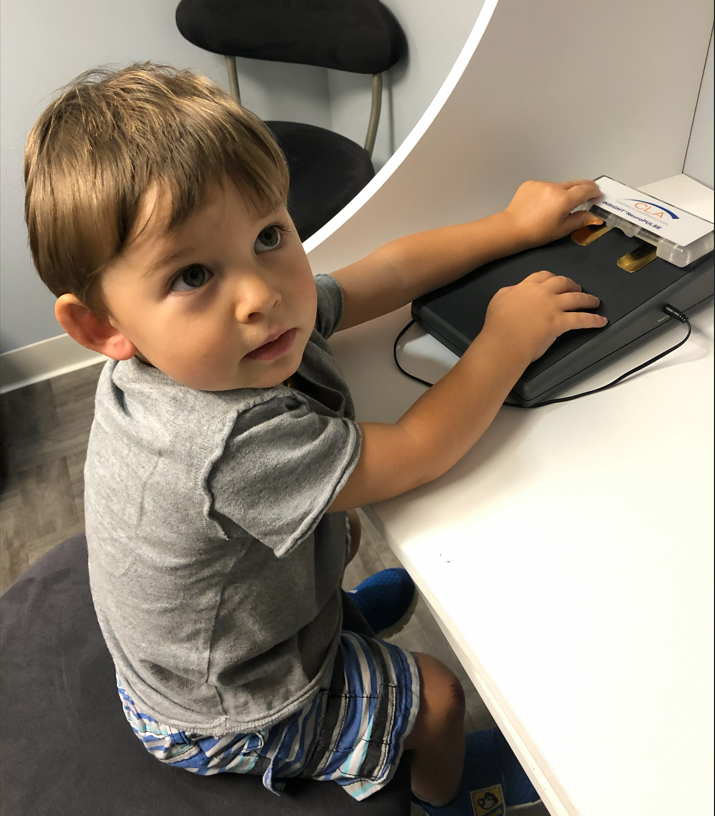
Our Neurological INSiGHT Scans allow us to evaluate several aspects of nervous-system function. Heart Rate Variability (HRV) gives us information about autonomic regulation and adaptability. NeuroSpinal EMG evaluates electrical activity associated with the muscles supporting the spine and can show us patterns of tension, energy use, and coordination. NeuroThermal scanning evaluates temperature patterns along the spine that can be influenced in part by autonomic regulation.
Together with the child's history and examination, those findings help us build a much more complete picture.
The scans don't diagnose ADHD, autism, sensory processing disorder, anxiety, or another medical condition. And we aren't scanning to determine whether your child is “good” or “bad” at regulating.
We're asking a much more useful question:
How is this child's nervous system functioning and adapting right now?
What We're Trying to Change Isn't Your Child's Personality
This matters enormously.
The goal isn't to take your energetic, adventurous, funny, intense kid and make them quiet.
We don't want the kid who loves running to stop running. We don't want the child who is passionate and expressive to become passive. We don't want to erase personality in the name of regulation.
Energy isn't the problem. Adaptability is the goal.
We want that energetic child to be able to run hard on the soccer field and settle into dinner afterward. We want them to be excited about something they love and transition when it's time to move on. We want their body to mobilize when a challenge requires it and then have access to recovery when the challenge is over.
That's very different from simply trying to make a child calmer.
Where Neurologically Focused Chiropractic Care Fits
When our consultation, neurological examination, and INSiGHT Scans indicate chiropractic care is appropriate, we use gentle, specific adjustments based on each child's individual findings.
Our goal is to support the neurospinal system and improve the nervous system's capacity to regulate and adapt—not to treat ADHD, sensory processing disorder, anxiety, or another diagnosis.
We also reassess neurological findings throughout care. That means we're not relying solely on whether a child had a good week or whether Mom thinks things “seem better.” We can compare what families are noticing in everyday life with changes we're seeing objectively over time.
And often, the everyday changes parents care about aren't dramatic medical outcomes. They're things like smoother transitions, settling more easily at night, recovering more quickly after becoming upset, tolerating changes with less overwhelm, or having more capacity available for school and therapy.
Those small changes can make a very big difference in family life.
Your High-Energy Child May Be Telling You Something
If you've spent years hearing that your child is “just hyper,” “just intense,” or simply needs to burn off more energy, but something in you keeps wondering whether there's another layer to the story, it's reasonable to ask more questions.
Your child's energy isn't something we want to take away.
But a nervous system should be able to do more than go. It also needs to slow down, organize, recover, rest, digest, connect, and adapt.
At New Hope Chiropractic in Charleston, we specialize in looking at that bigger neurological picture. Through a detailed consultation, neurological examination, and Neurological INSiGHT Scans, Dr. Angela and Dr. Chris can help you better understand how your child's nervous system is functioning and whether Neurologically Focused Chiropractic Care may be an appropriate part of their overall support.
Because the goal isn't less energy. It's better control of the gas and the brakes.
Related Articles
Understanding Emotional Dysregulation in Kids: A Neurological Approach
Sensory Overload in Children: What's Really Happening in the Nervous System
5 Steps to Smoother Back-to-School Transitions for Kids with ADHD + SPD
The Health Test Your Pediatrician Isn't Running (But Should Be)
Dysautonomia and Chiropractic Care
