
When we sit down with a new family at New Hope Chiropractic, we ask a lot of questions about pregnancy and birth.
Sometimes parents are surprised by that.
Their child may be four, seven, or even twelve years old. They came to us because of sleep struggles, sensory overwhelm, focus and attention challenges, big emotions, chronic tension, or difficulty regulating. So why are Dr. Chris and I asking whether labor was induced? Whether it was especially long or fast? Whether vacuum or forceps were used? Whether baby was breech or born by C-section?
Because your child’s nervous system has a history, and birth is one important chapter of that history.
A difficult birth doesn't always look dramatic. It doesn't have to mean 40 hours of labor, an emergency delivery, or weeks in the NICU. Sometimes everyone went home healthy and the medical chart says everything went exactly as planned.
But that doesn't mean the experience placed no stress on Mom or baby.
And sometimes, when we look back at a child's story years later, those early pieces help us better understand the patterns we're seeing today.
Birth Trauma Is Bigger Than a Birth Injury
When most people hear the words birth trauma, they picture a physical injury—perhaps a fracture, nerve injury, bruising, or another complication that was identified immediately after delivery.
Those certainly qualify, but the conversation about birth trauma has become much broader.
For Mom, a birth can be traumatic because of an emergency, unexpected intervention, severe pain, loss of control, fear for her baby's safety, or simply feeling unheard during an incredibly vulnerable experience. Research has found that a substantial percentage of women describe their childbirth experience as traumatic, even when there was no formally documented physical birth injury.
For baby, we're interested in something slightly different: what physical and physiological stress did the developing nervous system have to adapt to during pregnancy, labor, and delivery?
That's an important distinction. We're not saying every C-section, induction, fast labor, or assisted delivery creates neurological dysfunction. Many of these interventions are medically necessary and lifesaving.
We're saying that when we're trying to understand a child's nervous system today, the way they entered the world deserves to be part of the conversation.
Sometimes the Clues Show Up Early
For some families, the story begins almost immediately.
Baby has difficulty latching or strongly prefers feeding on one side. They seem uncomfortable when positioned a certain way. Maybe they're extremely fussy, difficult to settle, arch frequently, struggle with reflux or constipation, don't sleep well, or always seem to be tense.
Parents are often reassured that they'll grow out of it—and many babies do.
But other families notice that the concerns seem to change rather than disappear. The colicky baby becomes the toddler who never sleeps. The toddler who struggles with transitions becomes the preschooler overwhelmed by sound, touch, or change. Later, the concerns may involve attention, emotional regulation, anxiety, or behavior.
That doesn't mean a difficult birth caused every challenge that came afterward. Development is far more complicated than that.
But it does make us curious about the nervous system that has been adapting through all of those stages.
Understanding the “Perfect Storm”
At New Hope, we often talk about something called the Perfect Storm.
The idea is not that there is one event we can blame for everything happening with a child. In fact, it's almost always the opposite. We look at the accumulation of stressors across pregnancy, birth, infancy, and childhood and ask how well that individual nervous system has been able to adapt.
Maybe Mom experienced significant stress during pregnancy. Labor was induced and lasted a long time before ending in an emergency C-section. Baby then struggled with feeding, reflux, constipation, sleep, or recurrent ear infections.
Another family's story may be completely different. Pregnancy was peaceful, but labor happened extremely quickly. Or baby was breech. Maybe vacuum or forceps assistance was necessary. Perhaps delivery itself was uncomplicated, but infancy brought illness, injuries, medications, disrupted sleep, or other challenges.
One of those events by itself doesn't tell us what is happening neurologically.
The pattern is what we're interested in.
And importantly, looking back at that pattern isn't about assigning blame to Mom, Dad, an OB, a midwife, or anyone else involved in the birth. Birth doesn't always go according to plan. Interventions can be necessary, and sometimes the safest birth is very different from the birth a family originally envisioned.
We're simply asking: What did this nervous system experience, and how is it adapting now?
Why We Pay Attention to Birth Interventions
Labor and delivery place significant physical demands on both Mom and baby—even during an uncomplicated vaginal birth. When additional interventions are needed, those forces and physiological demands can change.
That's why our intake asks about things such as induction, C-section delivery, vacuum or forceps assistance, breech presentation, fetal distress, very long labor, and extremely fast labor.
We're especially interested in the head, neck, and neurospinal system because of their relationship with the developing nervous system. The upper cervical region is anatomically close to the brainstem, and sensory information from the spine continually communicates with the brain.
Again, an intervention on your child's birth record doesn't automatically mean something is wrong. It tells us that there's another piece of history worth considering alongside everything else we're learning about your child.
That's also why we don't make decisions based on birth history alone.
What Does the Vagus Nerve Have to Do With It?
If you've been around New Hope for very long, you've probably heard us talk about the vagus nerve.
The vagus nerve is an important part of the parasympathetic nervous system and helps participate in the body's regulation of functions including heart rate, digestion, and communication between the brain and many internal organs.
It's also part of a much larger autonomic nervous system responsible for constantly adapting to what's happening around and inside us.
We sometimes explain that system to parents using a car analogy. The sympathetic side is like the gas pedal, helping mobilize the body for action and stress. The parasympathetic side helps with the brake and recovery side—resting, digesting, restoring, and settling.
We don't want either pedal to disappear. We want the nervous system to be able to move appropriately between them.
For a baby, that adaptability can show up in very ordinary ways: moving between alertness and sleep, settling after becoming upset, coordinating feeding, digesting, and adjusting to an enormous amount of new sensory information.
That's why regulation matters so much from the very beginning.
What About Subluxation?
At New Hope, when we use the word subluxation, we're not simply talking about a bone being “out of place.”
We're looking at altered function within the neurospinal system—patterns of tension and altered movement that may influence the sensory information being communicated between the body and brain.
Our job isn't to look at a child's birth history and automatically declare that they have a subluxation. We examine them.
That's an important part of how we practice.
Your child's history tells us where they've been. Their examination and neurological scans help us better understand what's happening now.
We Don't Want to Guess—We Want to Measure
This is one of the reasons Neurological INSiGHT Scans are such an important part of our new-patient process at New Hope Chiropractic.
We use three different technologies to evaluate different aspects of nervous-system function. NeuroSpinal EMG measures electrical activity associated with the muscles supporting the spine and helps us evaluate patterns of tension and energy use. NeuroThermal scanning evaluates temperature patterns along the spine that can be influenced in part by autonomic regulation. Heart Rate Variability, or HRV, gives us additional information about autonomic regulation and the nervous system's ability to adapt.
These scans don't diagnose birth trauma, ADHD, autism, anxiety, reflux, colic, or another medical condition. Instead, they add objective information to the child's history and examination so we're not making assumptions based solely on symptoms.
For a parent who has spent years hearing, “Let's wait and see,” being able to finally take a closer look at neurological function can be incredibly valuable.
What Chiropractic Care Looks Like for a Baby
This is usually one of the first questions parents ask us—and understandably so.
Adjusting an infant does not look like adjusting an adult.
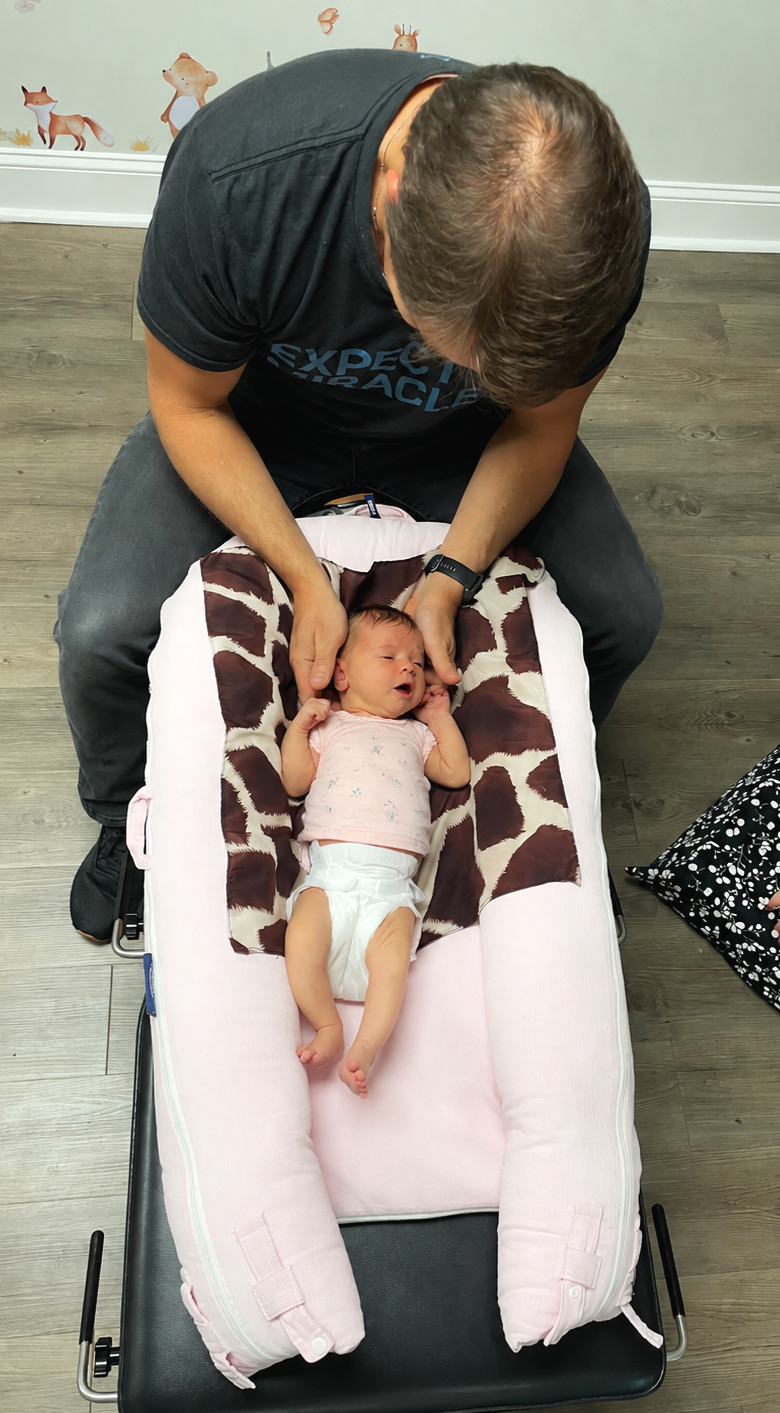
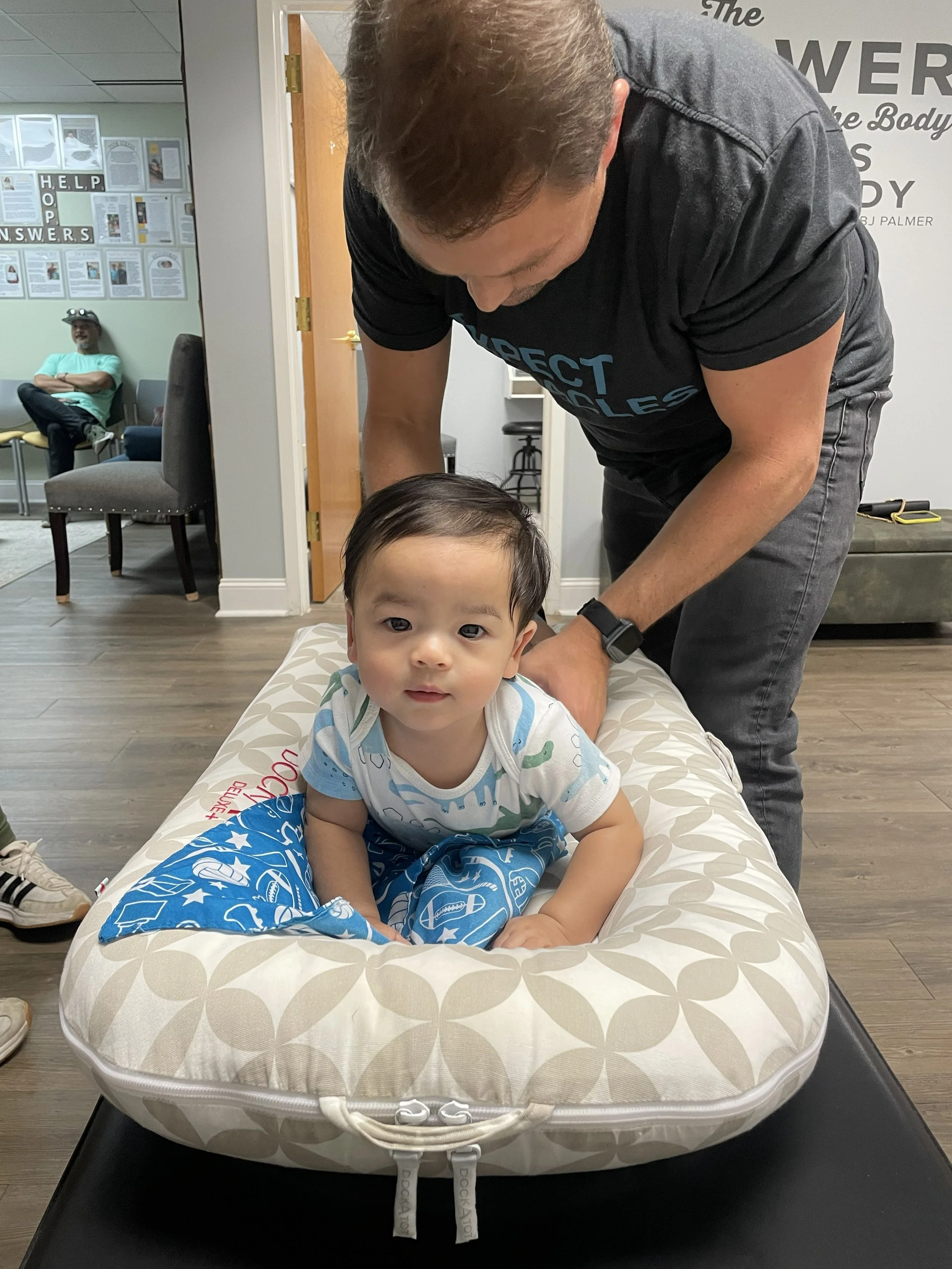
Pediatric chiropractic care at New Hope is extremely gentle and specifically adapted to the baby's age, size, development, examination findings, and nervous system. There is no forceful twisting or “cracking” involved in the way many parents picture when they hear the word chiropractic.
When care is appropriate, Dr. Angela and Dr. Chris use gentle, specific adjustments intended to support healthy neurospinal function and the nervous system's capacity to regulate and adapt.
And just as importantly, we don't want to guess whether care is creating change. We reassess throughout care so that we can compare what parents are noticing at home with objective findings over time.
Your Child's Birth Story Is Information—Not a Life Sentence
Maybe your child's birth was nothing like you planned.
Maybe you needed the induction you desperately hoped to avoid. Maybe everything changed quickly and a C-section became the safest choice. Maybe vacuum assistance was necessary. Maybe labor lasted forever—or happened so quickly you barely had time to process it.
Or maybe the birth was called completely “normal,” but something in you has always wondered whether those first hours and days mattered.
Your child's birth story matters, but it does not determine their future.
We're not interested in revisiting birth so that parents can carry more guilt. We're interested in it because understanding where a child's nervous system has been can help us ask better questions about where it is today.
At New Hope Chiropractic in West Ashley, we specialize in neurologically focused pediatric, prenatal, and family chiropractic care. If your baby or child is struggling and you keep wondering whether their birth story could be one piece of a much bigger puzzle, we'd be happy to sit down with you, listen to the whole story, and take a closer look at how their nervous system is functioning today.
Sometimes the first step toward understanding what's happening now is looking back at where the story began.
Related Articles
The Real Goal Was Never Symptom Relief—It Was a Thriving Nervous System
The Health Test Your Pediatrician Isn't Running (But Should Be)
Dysautonomia and Chiropractic Care
A Deep Dive Into Nervous System Regulation
Nurturing Your Child's Health: Unleashing the Power of the Vagus Nerve
